
How many times have you been at a meeting where your research has been circulated beforehand and as time goes on, it dawns on you that no-one has really processed your work? It’s frustrating, yes, but by no means a reflection on you, or even your intended target readers – but more on how you approached the task.
In 2026, the challenge has sharpened. The volume of reports, dashboards, AI-generated summaries and stakeholder communications landing in inboxes has grown significantly – which means the bar for content that actually gets read, processed and acted on has risen in parallel. The principles behind empathetic communication haven’t changed; the stakes for getting it right have.
Today, I suggest a different route to ensure your messages sink in and actually resonate with your audience.
I do this through the power of empathy in sharing research to ensure your content is read. You can apply this to UX research delivery, customer experience reporting, content strategy, mobile and web content design, copywriting and presenting – enabling you to make the impact you want.
We’re consistently told that human attention is harder to earn than ever. Research from the Nielsen Norman Group has consistently over the last 20 years shown that users spend the majority of their time scanning rather than reading – a pattern that has only intensified as content volumes have grown. The average person encountering a new document, report or presentation makes a near-instant decision about whether to engage with it properly or skim, and in a world saturated with information, that decision happens before you’ve made your first point. The challenge of earning genuine attention has never been greater.
In a nutshell, you’ve got to make those first moments count.
Why user-centred thinking applies to how you share research – not just what you design
The designer’s mantra of user-centred design optimises products for how users want to use them, rather than forcing a user to change their behaviour to use a product.
The same principle applies to ensuring your thoughts, reports or work in general gets noticed by the people who matter – by tailoring your material to the format that person lives and breathes.
A wise person knows their audience. A wiser person knows that even though you have worked weeks to produce an in-depth, comprehensive report that outlines your client’s market competitors, if you present them with a daunting 40-page document, they are not going to read it all.
And even if they are, you are relying on them to digest it as you want them to and not just skim. You are tempting fate and risking some of your hard work being lost
“When creating content, be empathetic above all else.
Try to live the lives of your audience.”
Rand Fishkin, Founder at Moz
How to tailor research delivery to your audience
During a recent client’s fund raise, we must have tailored 20 different slide-decks, one-pagers, 2-pagers, white papers, infographics, teasers, even an explainer video to potential investors and partners all over the globe, with different approaches for different people based on our knowledge of the people we were pitching to and previous interactions with us and the team.

Tailoring your content to individual consumers, whether it be document, visual or video
Tailoring your content to the reader, while time-consuming, is perhaps the most effective way of ensuring your work is noticed. This is empathy; this is showing respect for the person in question, for their time, and actively building rapport. But, from a business point of view, it ensures your pitch hits the nail on the head.
Three principles for research that actually gets read
- Structure – Make reading the document consistent. Don’t strain attention or focus with lots of random pages or treatments.
- Underscore the topic – Give them something to lock their attention to.
- Brief descriptions – Keep it brief and to the point, and finally – only communicate what is relevant to the person.
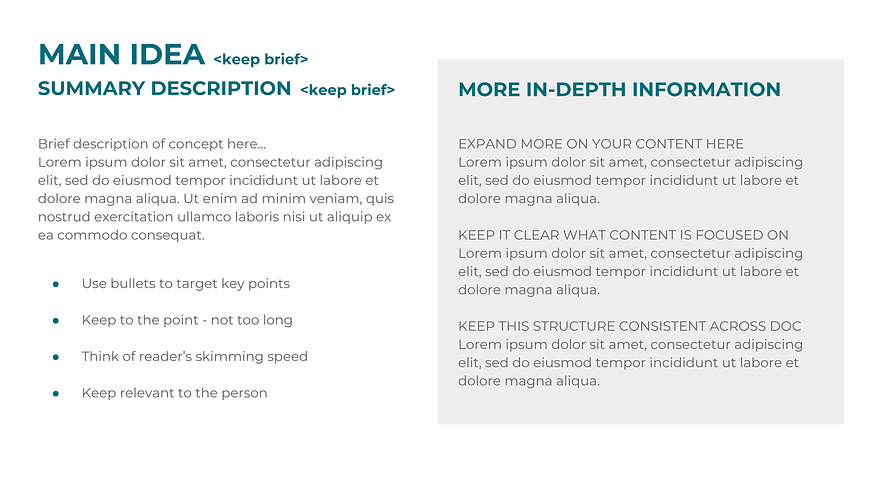
Keep your documents structured with key info first, followed by a more in-depth look
If you can, take the time to ask them what they want from you in terms of communication. It’s one question they will respect you for asking and will make your job infinitely easier.
And while we’re talking about clarity of message, don’t assume that because you understand the technical jargon being thrown around, your clients or colleagues do too. A lot of modern acronyms and tech concepts are lost on the general public and there is a lot of pressure to be informed on all the different things going on in the digital space. Never assume that because you know it, they know it.
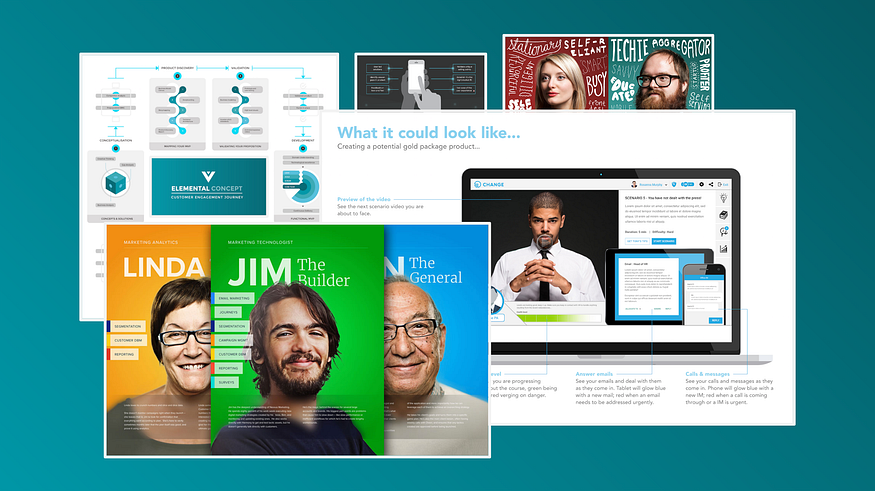
Support your research by creating visuals and assets to share high-level information
Help others get there. Help them understand.
Infographics, explainer videos, posters – these are so effective for maintaining a decent high-level understanding throughout a team and are a great way to support clients who may be struggling to convey concepts to non-technical investors, stakeholders or their own leadership.
We can all relate to this. There is a lot of information in the world so we should never assume we are all singing from the same hymn sheet.
Gauge your client like a user: are they more visual, are they more fact-driven, do they enjoy a deep dive, or do they prefer to see the charts and figures as opposed to write-ups?
Ask them for copies of reports or emails that they’ve actually enjoyed and are more likely to respond to. Ask them to define what they need in a report before you write it, and you’ll find your job is going to be much easier when you need to deliver it.
That’s not to say you cut content to the point of madness. Section your document relevant to the reader while including a link to the entire document. Structure it well, with easy to find, digestible sections – but always assume this will not be read in full. Steve Krug nails it perfectly when describing web users:
“They don’t read, they scan.”
Steve Krug
Trust in the time spent getting to know your clients, colleagues and end users.
Knowing their drivers, knowing what they respond to and why they do what they do is never a bad investment of time. The power of your relationships will always pay dividends in the workplace.
This also lets you find the freedom to be your authentic self at work – acting on instinct, asking honest questions and diving deeper to get a better understanding because you are emotionally committed to doing right by the person, not just getting the task done.
The business case for empathetic communication in customer experience work
The rise of AI-generated summaries and automated reporting has made this more acute, not less. If anything, the proliferation of machine-produced content has raised the value of communication that feels considered, human and tailored – because that is increasingly what distinguishes research that moves people from research that gets processed and forgotten
In customer experience and UX research, the gap between insight and impact is almost always a communication problem. The research exists. The findings are solid. But if the people who need to act on them – product owners, commercial leads, senior stakeholders – haven’t engaged with it in a form that works for them, the work stops at the deliverable. Empathy in how you share research is not a soft skill – it is what determines whether your work changes anything.
The benefits of this approach – simple:
- You’ll get your point across faster
- Get buy-in faster
- Move processes along faster
- Strengthen your relationship with the client or target reader
The target readers will appreciate the effort to deliver to their remit and this massively increases trust in you and your work. This is why clients stay with you.
Empathy is the ability to understand and share in the internal states of others – and it’s an invaluable tool, not only in your UX arsenal but your toolkit generally. Every interaction you have benefits from this skill because it can be the catalyst for better products, stronger client relationships, and more impactful customer experiences.
So to sum up:
Don’t lock yourself into one format – adapt your approach.
Tailor-fit content to the person – don’t overwhelm with a one-size-fits-all.
Ask your audience how they want to digest information – always have at least one reference.
And remember – you’re dealing with the equivalent attention span of an inattentive goldfish most of the time. Make it impactful!


